


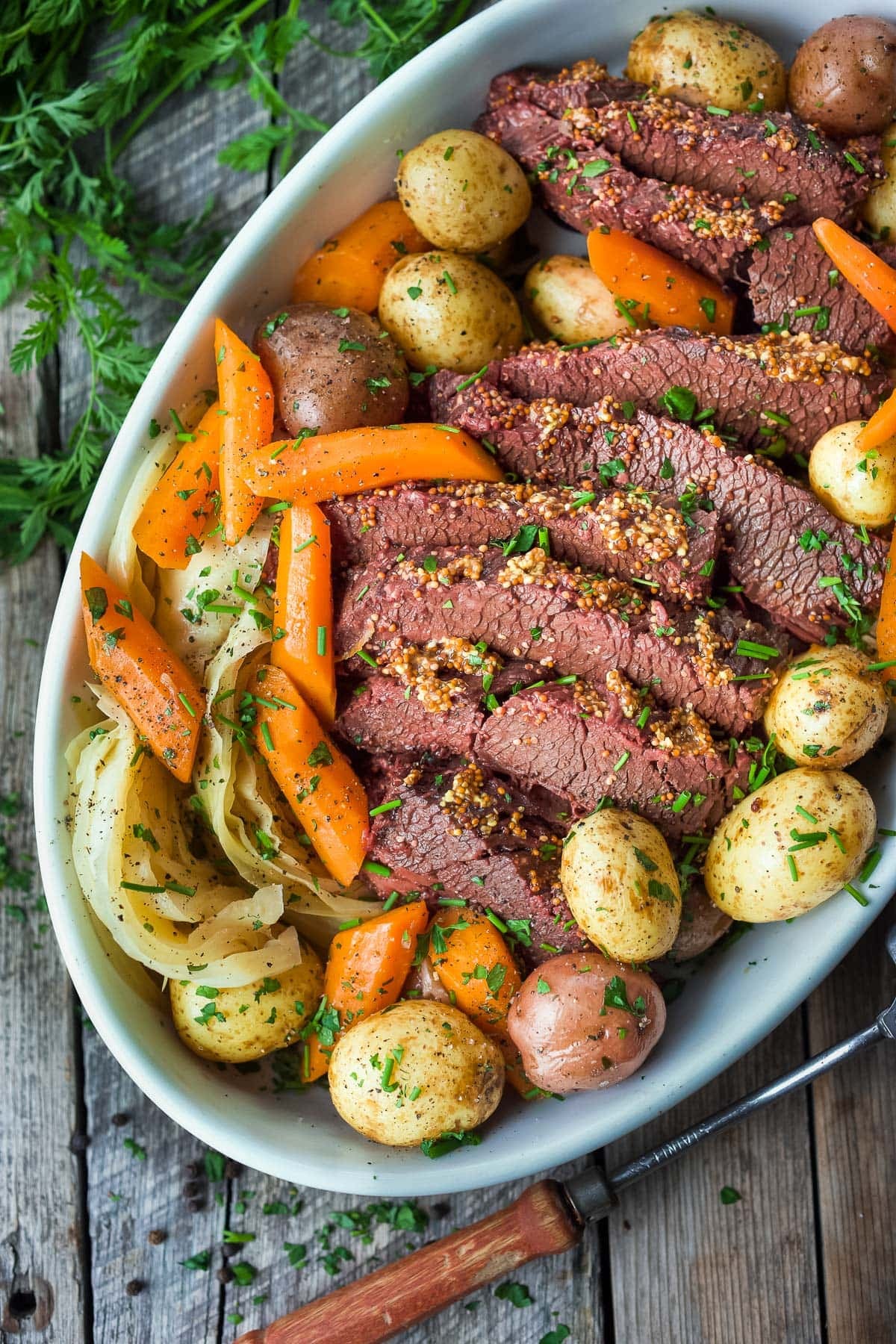
How to make your own home-cured Corned Beef Brisket, with flavorful brine, pickling spices, and celery juice. Allow 5-10 days curing time before simmering it in your slow cooker or baking it in the oven. Tender and flavorful!
Death is not the greatest loss in life. The greatest loss is what dies inside us while we live. ~
This homemade Corned Beef recipe comes just in time for St. Patrick’s Day. I think we need to take advantage of any ritual and celebration these days and create our own when inspiration strikes. Fin, my 11-year-old, said recently, “Mom ritual gives me certainty.” It really struck me!
He named something for me that I definitely experience and want to foster, especially when things feel unknown and security is elusive. I am often floored by the wisdom that flows from my kids.
I am inspired to create more rituals in our family rhythms. These acknowledged occasions give us a place and time to come together and memories to share. So, we will have a St. Patrick’s Day celebration with a nod to my husband’s Irish heritage! We will be creating a meal that will include this home-cured corned beef brisket.
What is Corned Beef?
Corned Beef is made from beef brisket, which is cured in a salt and spice brine ( much like a pickle brine) for a week before being slow-cooked in a slow cooker, until tender and falling apart. Nitrate-free corned beef or “naturally cured” corned beef uses “natural” nitrates (in this case, celery juice) as a healthy alternative.
Corned Beef Recipe Ingredients
- Beef Brisket: Try to the best quality beef you can. Opt for pasture-raised, grass-feed beef brisket. A great source is at your local farmers market.
- “Natural” Nitrates: A natural way to cure your own corned beef is to use celery juice, (which contains natural nitrates in addition to a whole other host of benefits), sauerkraut brine (full of active probiotics and natural preservatives), and mineral salt. (You can read more about celery’s nutrition and a detailed explanation of how to juice it here.) You can juice your own celery at home, or if you don’t have a juicer, use a blender and strain, or find celery juice at gourmet grocery stores or at a juice bar.
- Pickling Spice Blend: Pink Himalayan Salt, Black peppercorns, mustard seeds, cinnamon stick, whole cloves, coriander seeds, cardamom, red pepper flakes, & bay leaves. Optional additions: allspice berries, juniper berries,
- Optional: A slice of beet or beet juice ( for vibrant pink color)
- Veggies: onion, carrots, celery and garlic cloves
How to make Homemade Corned Beef Brisket
Corned Beef is basically salt-cured meat, usually beef brisket. This process preserves and seasons the meat while enhancing tenderness and adding flavor with spices.
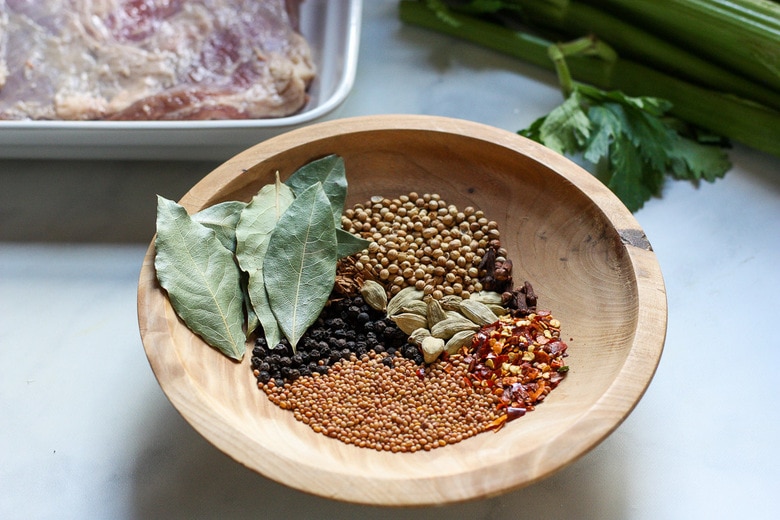
Pickling spices are essential in creating the traditional flavor of corned beef. Here is our pickling spice blend! Today we’re using grass-fed, pasture-raised beef to make our corned beef brisket.
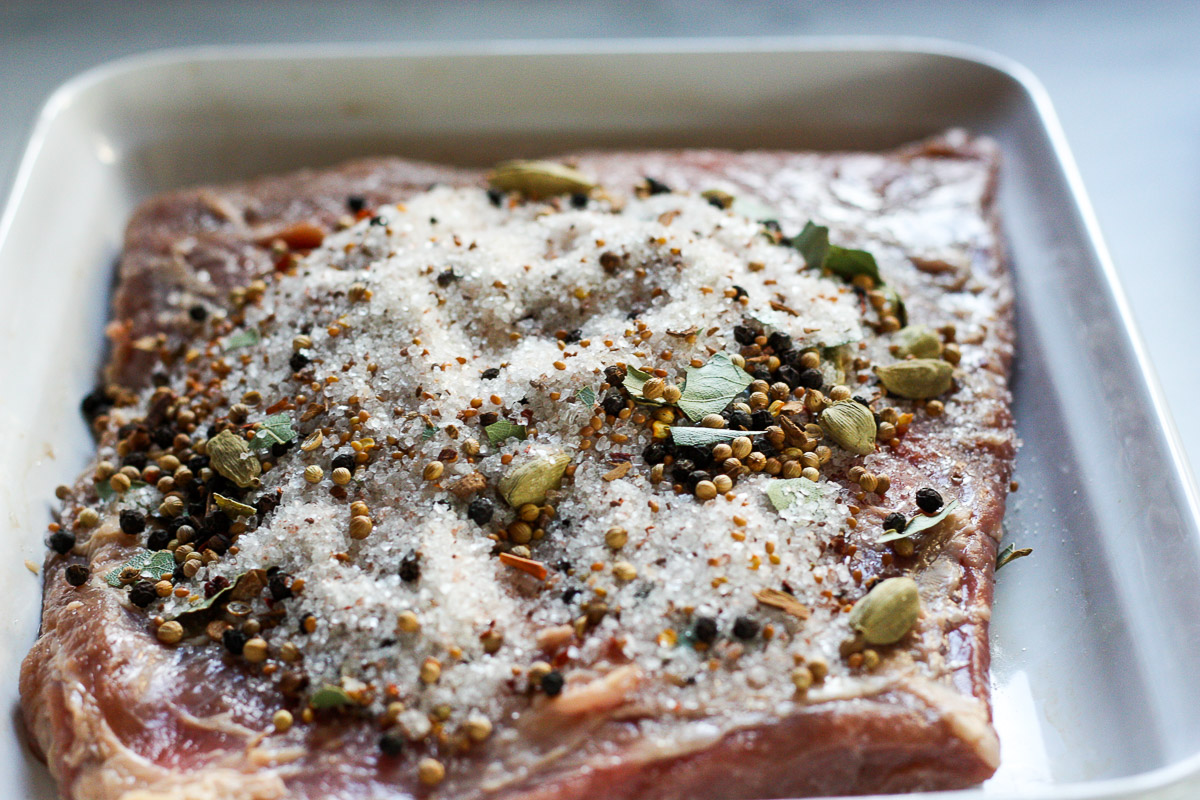
Massage both sides of the beef brisket with salt and pickling spices.
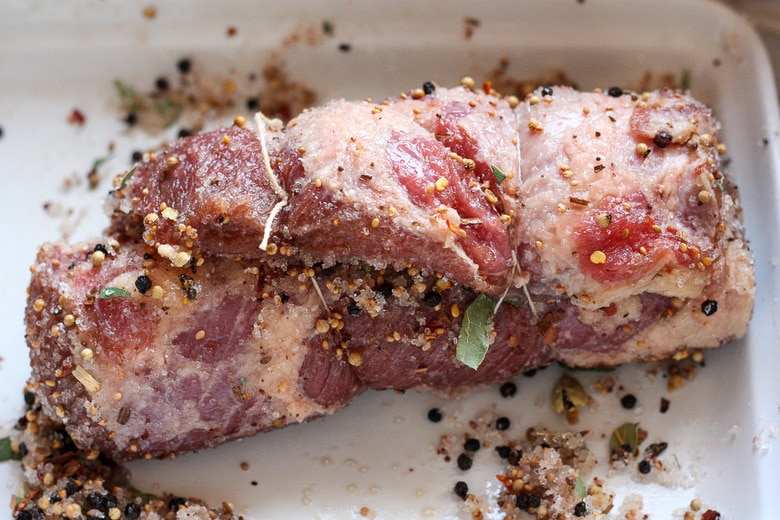
Roll up with spices inside and tie to make a nice little bundle keeping the spices right close to the meat for ensured flavor.
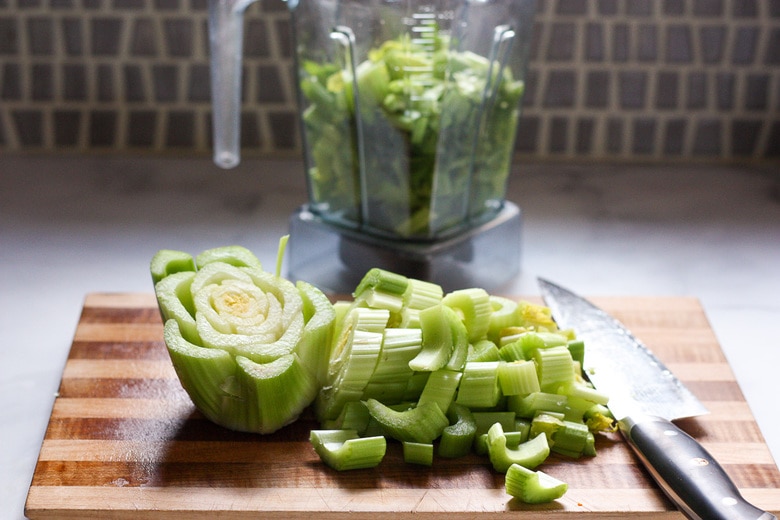
Celery juice contains natural nitrates. One bunch of celery makes about 2 cups. I used a vita-mix and blended it up smooth and then strained through a cheesecloth.
I did the same for the beet juice ( which adds beautiful color!) Beet powder is also an option if it is available to you.
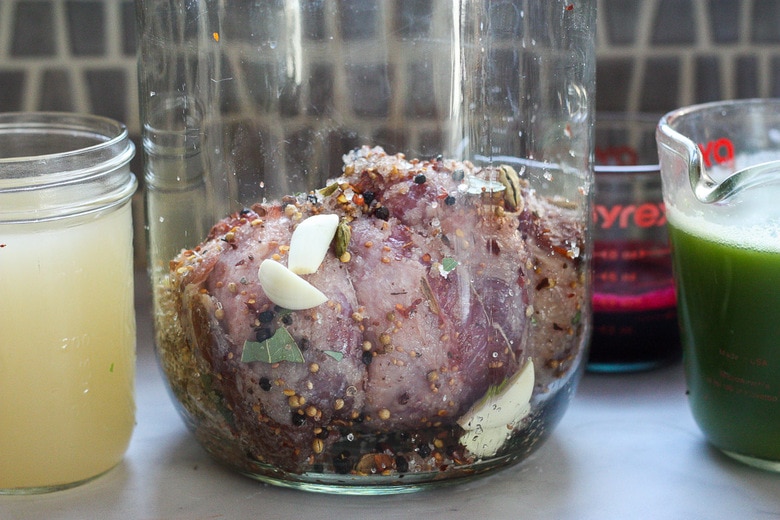
Place the rolled meat and any remaining salt, spices, and whole garlic in a glass or ceramic vessel that has a lid, lodging it in the bottom where it will stay fully submerged under the brine. (You can also place a weight, a small plate or a small bowl directly on top of the meat if needed).
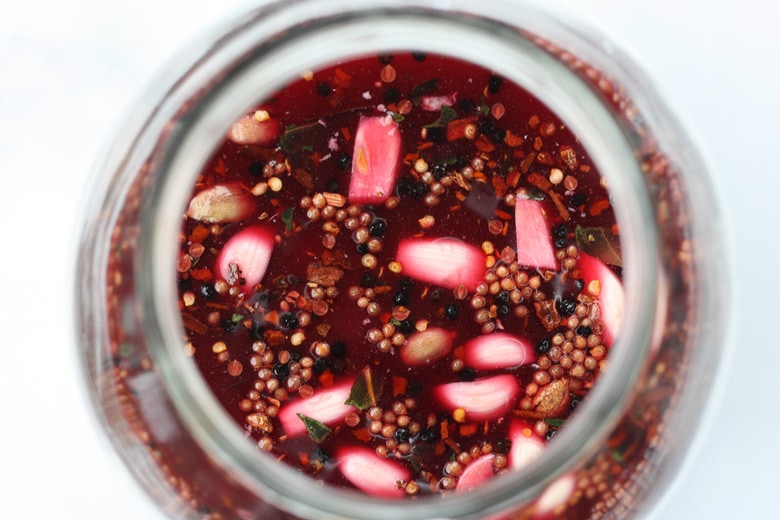
Pour in the celery juice, sauerkraut brine, and beet juice (for color). Now it is ready to cure.
Cover and place in the refrigerator for 5-10 days.
Both sauerkraut brine and whey are starter cultures, already active giving your curing a boost. Either work in this recipe.
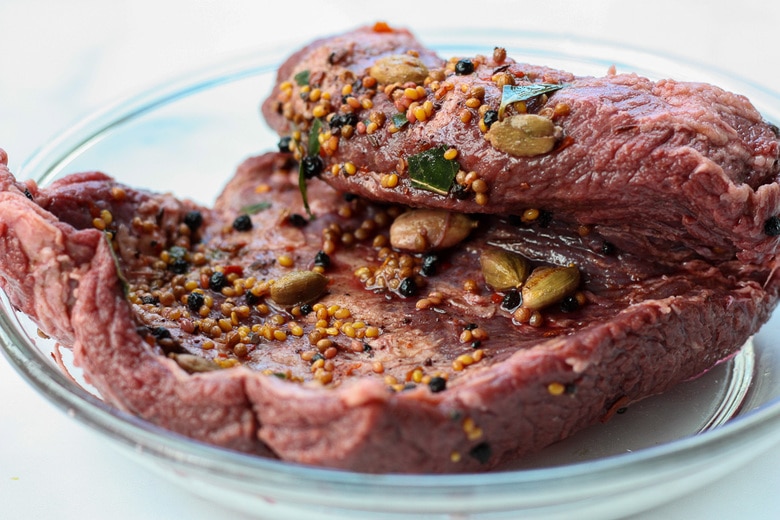
Rinse thoroughly after removing from brine- for lower sodium, you can soak in water up to two hours. Your beef is now officially corned!
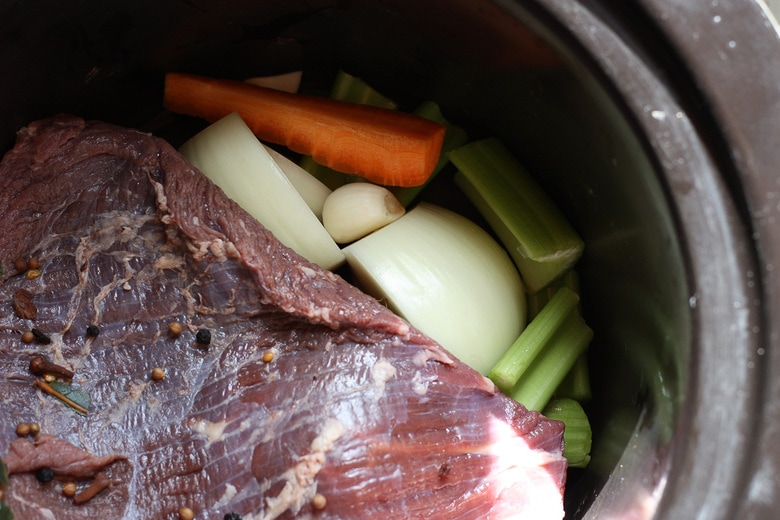
Cook the Corned beef
Place the Corned Beef in a slow cooker on high 4-5 hours, and simmer until fork-tender. Alternatively, boil on the stovetop in a covered pot, or bake it in the oven (see the recipe card).
Serving Suggestions
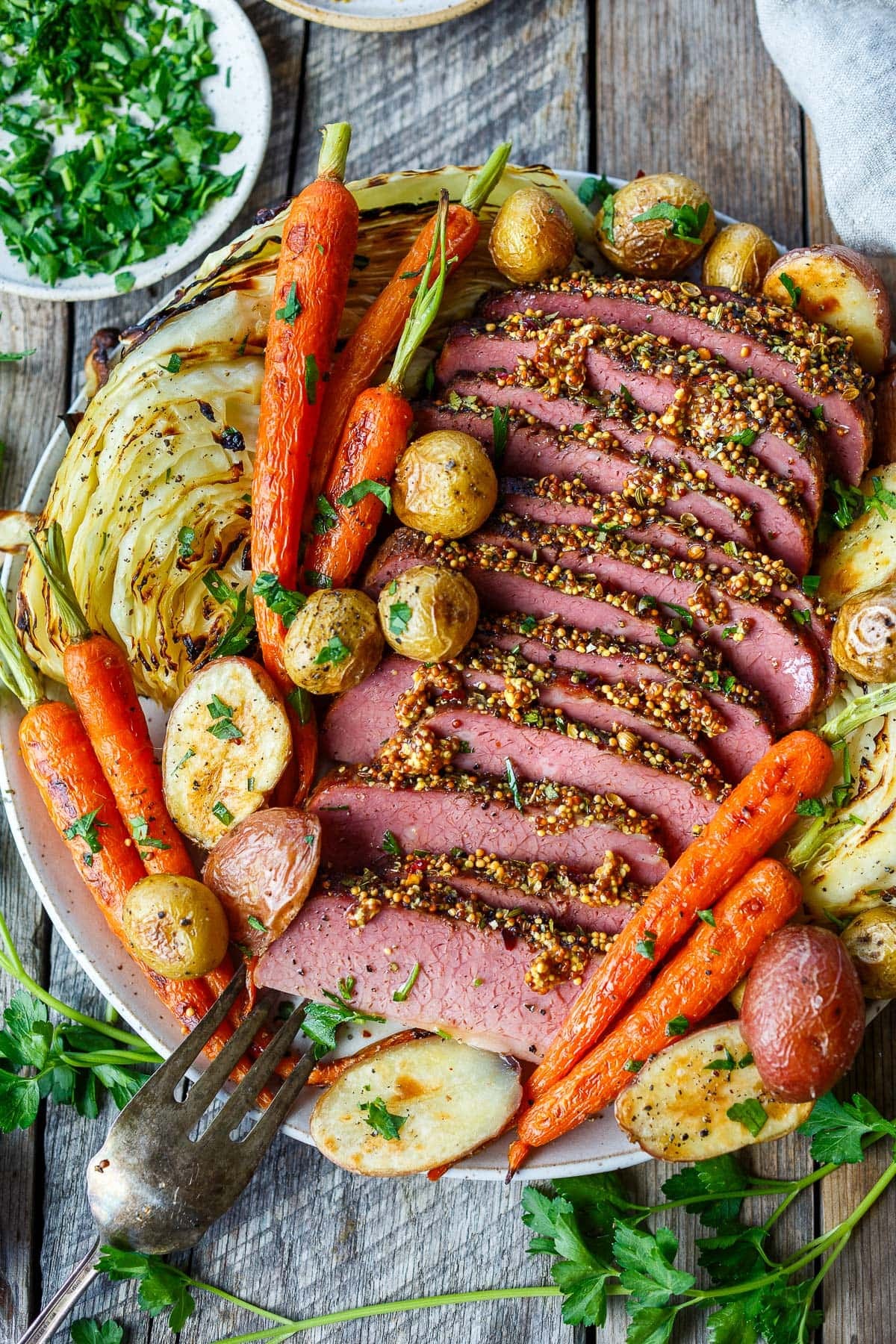
Lather with whole grain mustard, slice across the grain and serve with roasted vegetables or roasted cabbage steaks along with mashed potatoes or Finnish Boiled Potatoes.
Storage
Store leftovers in an airtight container in the refrigerator for up to 4 days, or freeze for up to three months. Leftovers can be repurposed into this Corned Beef and Cabbage Soup. Or shred it and add to Reuben sandwiches, or make corned beef potato hash!
I really love thinking about how back in the day this was just what one did to preserve food – not so much focus on ” good for you” or “bad for you”. It was all about survival. Food was pure, and the methods simple.
Our ancestors were clever in creating both sustenance and flavor. There is something very gratifying about learning these ancient ways that are wholesome, full of natural nutrients and delicious in their simplicity.
More Beef Recipes you may like:
- Corned Beef and Cabbage Stew
- Homemade Meatloaf
- Rib Eye Beef Roast with Wild Mushrooms
- Instant Pot Beef Stew with Root Vegetables
- Simple Irish Stew
- Oven Beef Brisket
- Grilled Steak Tacos
- Crispy Herby Smashed Potatoes
Hope you enjoy this naturally-cured homemade Corned Beef Recipe!
Print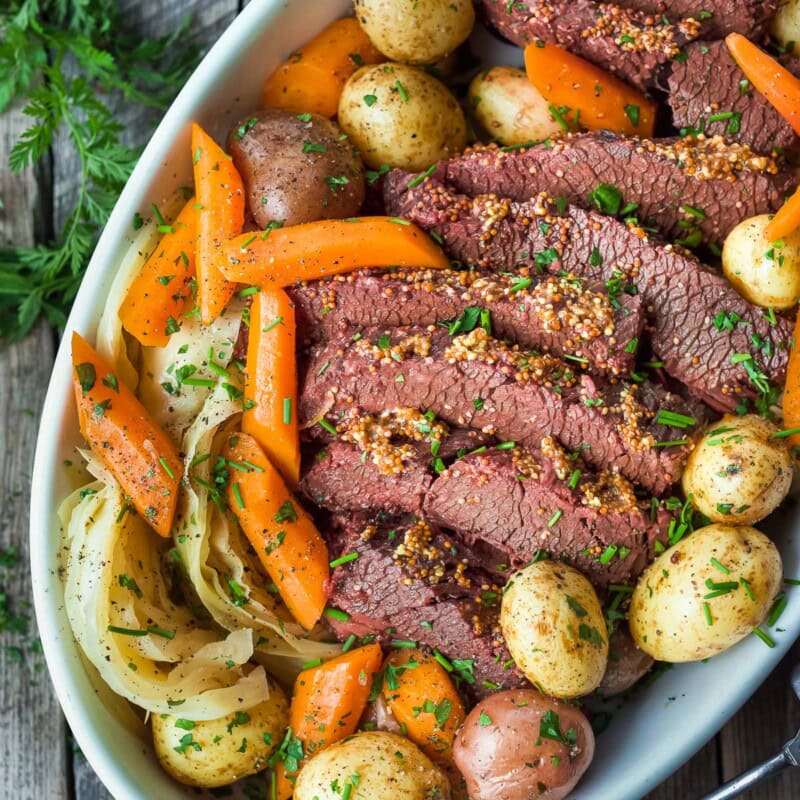
Homemade Corned Beef Recipe
- Prep Time: 60
- Curing Time: 5 days
- Cook Time: 5 hours
- Total Time: 126 hours
- Yield: 8 1x
- Category: beef recipe, Dinner, holiday
- Method: Baked, Cured, slow cooker
- Cuisine: Irish
- Diet: Low-Carb
Description
How to make your own homemade Corned Beef with natural nitrates from celery juice. It is easier and healthier than you may think! Allow one-week curing time.
Ingredients
- 2-3 pound thawed beef brisket (grass-fed preferred)
- 3 bay leaves
- 1 cinnamon stick
- 2 tablespoons mustard seeds
- 2 tablespoons whole coriander seeds
- 4 whole cloves
- 1/2-1 teaspoon red pepper flakes
- 1 tablespoon whole black peppercorn
- 1 tablespoon whole cardamom pods
- 2/3 cup sea salt or mineral salt
- 1/4 cup cane sugar
- 2 cups celery juice (1 bunch celery, see notes)
- 2 cups sauerkraut brine, whey (see notes) or beet kvass
- 1/4 cup beet juice or 1 tablespoon beetroot powder, or a few slices of fresh beet, optional (for color)
- 5 cloves of garlic
- 3 cups water
- 1 onion
- 2 cloves of garlic
- 2 celery
- 1 carrot
- 1/2 head of cabbage
Instructions
Brine the meat:
- Rinse the beef brisket and pat dry. Trim the fat to 1/4 inch or remove it completely.
- Break up the cinnamon stick and bay leaves, and lightly smash the cardamom. Mix together with mustard seeds, coriander, cloves, red pepper flakes, salt, and sugar.
- Thoroughly massage the spice/salt mixture into the meat (non-fat side). Roll it up tying with string to secure. Place rolled up brisket in a large jar or glass bowl.
- Pour sauerkraut brine, celery juice, and beet juice (if using) over the meat. Make sure the meat is fully submerged. Throw in the garlic cloves. Seal with lid.
- Place the jar in the refrigerator for 5-10 days to cure.
- Unwrap, rinse, and soak it in water for 1-2 hours to remove the salty flavor.
Cooking the Corned Beef
- Slow Cooker: Prepare onion, celery, carrot and garlic cutting in large chunks and place in the bottom of a crockpot. Place the meat on top of the vegetables (the fat side up) along with 4 cups of water. Cook on high for 4-5 hours, or 8-9 hours on low, until the meat is tender and easily forks apart.
- Baking instructions: Place the corned beef brisket in a Dutch oven or heavy pot with a lid (or cover tightly with foil). Add 2 cups water, broth, or beer. Cover and bake at 350°F for 1 hour, then reduce heat to 300°F and continue cooking 3–4 hours, until a fork slides easily into the center.
Cooking time will vary depending on the thickness of the brisket. Roast vegetables on a separate sheet pan, or add them to the pot during the last 2 hours of cooking.
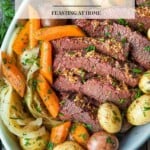
To serve, slice the corned beef against the grain. Platter with the veggies and sprinkle with fresh parsley.
Notes
You can use sauerkraut brine, our gut shot brine, or beet kvass, which you can make from your own batch of homemade sauerkraut — or strain store-bought sauerkraut. 1-quart yields about 1 1/2 cups. This amount will vary depending on the brands. You can also buy Beet Kvass.
Celery juice can be made with a juicer, or blended in a blender with 2 cups water (then strained) or feel free to use store-bought celery juice.
If you choose to use whey, you can strain full-fat yogurt in a strainer lined with cheesecloth over a bowl left out at room temperature for about an hour. 1 quart usually yields a bit more than 1 cup of whey. The yogurt will now be thick – “labneh”.
Adding vegetables to the crockpot when cooking the meat is totally optional, it just adds more savory flavor. Alternatively cooking in just water will work just fine.
Store the cooked corned beef in the fridge up to 4 days in a seal container. Or freeze for 3-4 months. I like to freeze in meal sized portions.
Nutrition
- Serving Size: Used a 2 lb brisket - 4 ounce portions
- Calories: 235
- Sugar: 6.3 g
- Sodium: 966.5 mg
- Fat: 9.3 g
- Saturated Fat: 3 g
- Carbohydrates: 12.9 g
- Fiber: 2 g
- Protein: 25.2 g
- Cholesterol: 70.3 mg






Can I lower the amount of salt used to make this? I have a toddler at home and am careful about high sodium foods.
The salt is an important part of the fermenting process, keeping the bad bacteria away and encouraging the good bacteria. It is possible to use more whey and less salt for fermenting but I have not tried that with this recipe.
Is the sugar necessary? I can’t have sugar but maybe can I replace with another sweetener like date sugar? If not can I just take it out?
It is just going to balance the flavors but it should be fine without.
Hi, your recipe looks delicious. However, my celery turned to puréed celery rather than celery juice. And my whey definitely had some milk solids coming through. So, I’m wondering, is this mixture really going to last 10 days? Should I replace it?
Could you try straining it through cheese cloth?
We’re trying this recipe because of the difficulty in getting “curing salt” where we live. With some minor local taste variations in the ingredients, its been soaking for a week now. Cook it up tomorrow and we’ll see how it tastes! Thank you for making an alternative method available, i was begining to stress over the lack of traditional curing ingredients since i’d already purchased the meat. 😉
Great, let us know how it turns out!
Your post for corned beef incorrectly referred salt as sodium nitrate when in fact it is “sodium chloride” which are different compounds.
To my understanding, some salts MAY have nitrates naturally. Curing salt has nitrate added. Where I live, I am able to buy natural sea salt imported from France, with NO additives. It’s a bit courser and has a tendency to clump but has a superior flavor over the “free-flowing” commercial boxed salts.
Please don’t give good salt a bad name.
Thanks for the clarification Marilyn! It is good to know where your salt comes from and the purity of it. I think some people are not aware of the additives in many salts and all the micro plastics now found in most sea salt.
So… delighted to find this recipe, I brined my brisket today – it was possibly a bit under 2lb once trimmed and I’ve done it in a ziplock bag so it didn’t need 4 cups brining mix – I did 1 – 1.5 cups each of whey and celery blended with 2 baby pickled beets, so 2-3 cups total. I am worried now that i will have over salted the brine because i didn’t reduce the other ingreds and it’s a small brisket.
Should i worry? Would soaking before cooking help (after rinsing off the rub)? Would a shorter brining period be better? ( I was gonna do a 10 day brine) I’m probably overthinking but would welcome advice.
Thank you!
So you used the full salt measurement but less liquid? It might be a little salty. The longer brine time will actually dissipate the salt as it ferments. I think 10 days is fine! Yes before cooking, soaking in clear water for an hour or so, changing the water after 30 minutes will help.
Thank you for your reply Tonia – yes I made the rub and covered the meat with it before doing the brine and just hadn’t thought ahead properly. Hopefully I’ve not ruined it! I shall try the rinse/soak and cross my fingers! Thanks again.
I think it will be fine! Maybe just enjoy with some extra unsalted potatoes.:)
Hi again Tonya – Just wanted to give a quick update after your advice:- I soaked in 2 changes of water as suggested with an extra one for luck🍀and we ate with colcannon mash. It was really good! Not overly salty at all. Thank you again 😊
Oh cool Julia! So happy to hear it all worked out! Thanks for circling back and letting us know.
The best corn beef that I’ve ever had I used low sodium salt and I accidentally did 2 cups of beet juice and I let it marinate in the refrigerator for four days turned out excellent
Yay Michelle! So great to hear.
Just put in the fridge but we ended up needing a lot more liquid to fully cover the brisket. Do we need to add more salt to prevent botulism? Or is it okay the way it is. We probably added another 4-5 cups of water/celery water
Hi Jennifer, Yes I think adding another tablespoon of mineral or pickling salt would be a good idea. Fermenting brine is generally 1 tablespoon to a quart of water. Let us know how it works out!
I would like to corn a whole brisket point and flat, how long will is too long?
Hi John, You should be able to do that just fine with the same instructions. Does that answer your question?
Is the kraut brine just salt water? When I make sauerkraut I usually don’t have to add brine since the cabbage ends up making its own.
Yes, the salt water from the kraut. 🙂
I forgot to strain the celery juice, used my thermie to blitz it up. I hope it will be ok?
It should be!
FYI Whether nitrites are added from a pure salt or created in situ by bacteria acting on the natural nitrates in celery juice makes little difference. Nitrites are nitrites and they work by inhibiting dangerous disease-causing bacteria, but in high concentrations will react with amines (in meat) to produce reactive nitrosamines (and these are nasty chemicals you do not want to eat).
The nitrates from celery juice don’t actually cure the meat–it’s the nitrites produced by the action of good bacteria (from the sauekraut brine) on the nitrates that supports meat curing and inhibiting Botulinum clostridium. The trick tho is that unlike when you specifically add nitrites (salt peter) from a pure source in a safe and pre-determined quantity, it is hard to quantitate what you produce through bacterial action on the nitrates in celery juice. So this is in fact less controlled and potentially riskier since the bacterial activity of the sauerkraut will vary from batch to batch depending on its age and composition. No judgement here, just a heads up.
An informative and lay person friendly commentary on nitrites and their risks (from the office of science integrity at McGill University)
https://www.mcgill.ca/oss/article/food/celery-juice-viable-alternative-nitrites-cured-meats
Thanks for the info Bri, interesting!
Hi Sylvia,
I have enjoyed making quite a few of your recipes, but this is the first time commenting. The flavor of the brisket was wonderful. Loved the spice
mixture. Never liked corned beef that much until now. I had some Just Beet juice from Whole Foods that I used and it gave it a nice color and sweetness, too. Thanks for sharing your wonderful recipes!
So happy you enjoyed this Vivian! Thanks for the kind words. 💛
Would the juice from pickled beets work?
If you mean instead of the beet juice, I think that would be great!
Hi Sylvia
I have so much whey from making yogurt. Do I have to use celery juice/water or can I rely on whey to do the curing.
Thanks for the wonderful recipes.
Regards
Laura
Hi Laura, I have always used celery, my understanding is that it is important for the natural nitrates it contains. But you can use the whey instead of sauerkraut brine.🙂
Great recipe and felt so proud to have made it from scratch like that 🙂
yay! so happy to hear this. good job!!!
Do I put in all the salt mixture into the brine? There is a lot left over after I rub it into the meat.
yes
Could this also be cooked in my instant pot after it’s brined? if so, how long? 1 hour? (3.5lb brisket)
I have not tried it but I am sure it would work fine.
Does the lid need to have an airtight seal?
no, just well covered.
When cooking the beef is it still tied up, or untied?
Is chicken stock ok to use with the water – perhaps half of each?
Untie the meat and rinse really well with running water. I suggest cooking in water as it mellows the salt that the meat was cured in and the meat is so flavorful that it doesn’t need much more.
I have a 7 pound brisket and I don’t have a large enough glass or ceramic container, would a stainless steel pot be okay to use?
I think that should be ok!
Thank you
I’m pretty sure you need to stick with either a glass or a ceramic container, or perhaps a large freezer style zip-lock bag.
I’m assuming that is “4 cloves” of garlic?
4 whole cloves, the spice!
Will definitely try! Always wanted to do but scared of nitrate.
Tnx!
Awesome, thanks! Nitrate is one of my Crohn’s triggers, well man-made nitrates that is. I tolerate celery nitrates fine 😋
Do you need to seal the container of marinating meat in the refrigerator ?
Yes, I will make that more clear in the recipe.