

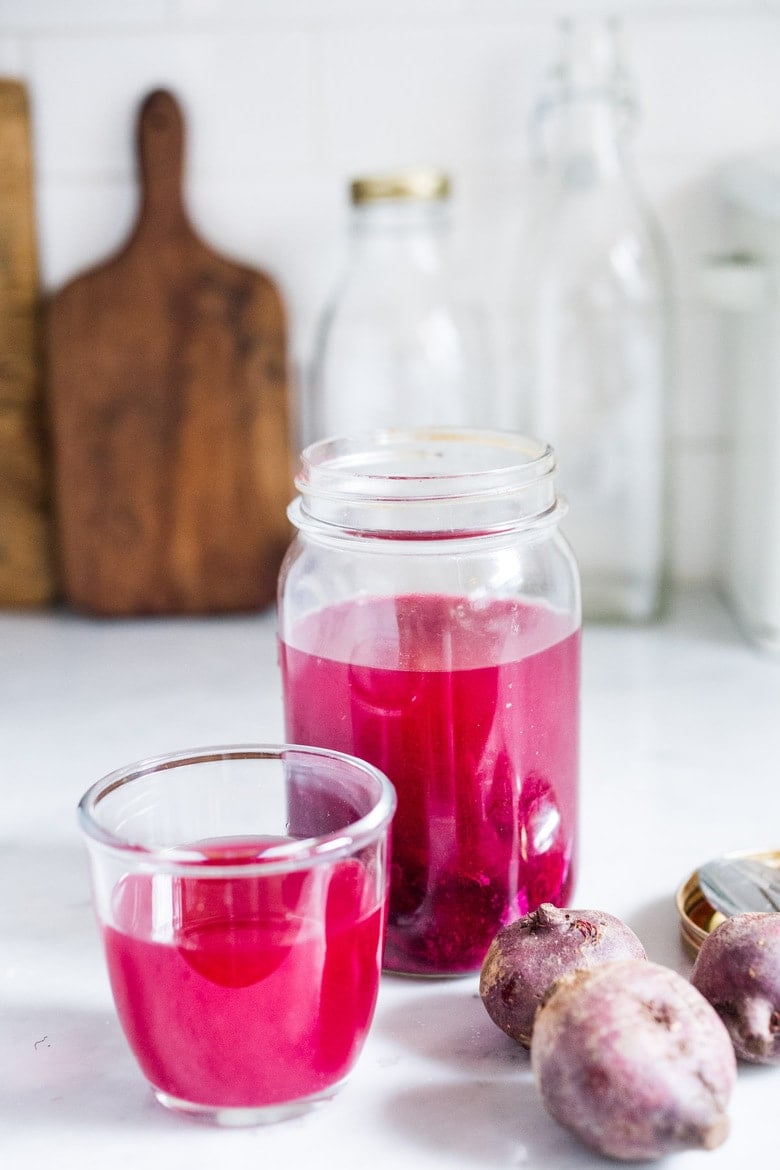
How to make Beet Kvass- an Eastern European probiotic drink made with fresh beets, sea salt and water. Full of healthy probiotics from Lacto-fermentation, these good bacteria heal the gut and support immunity.
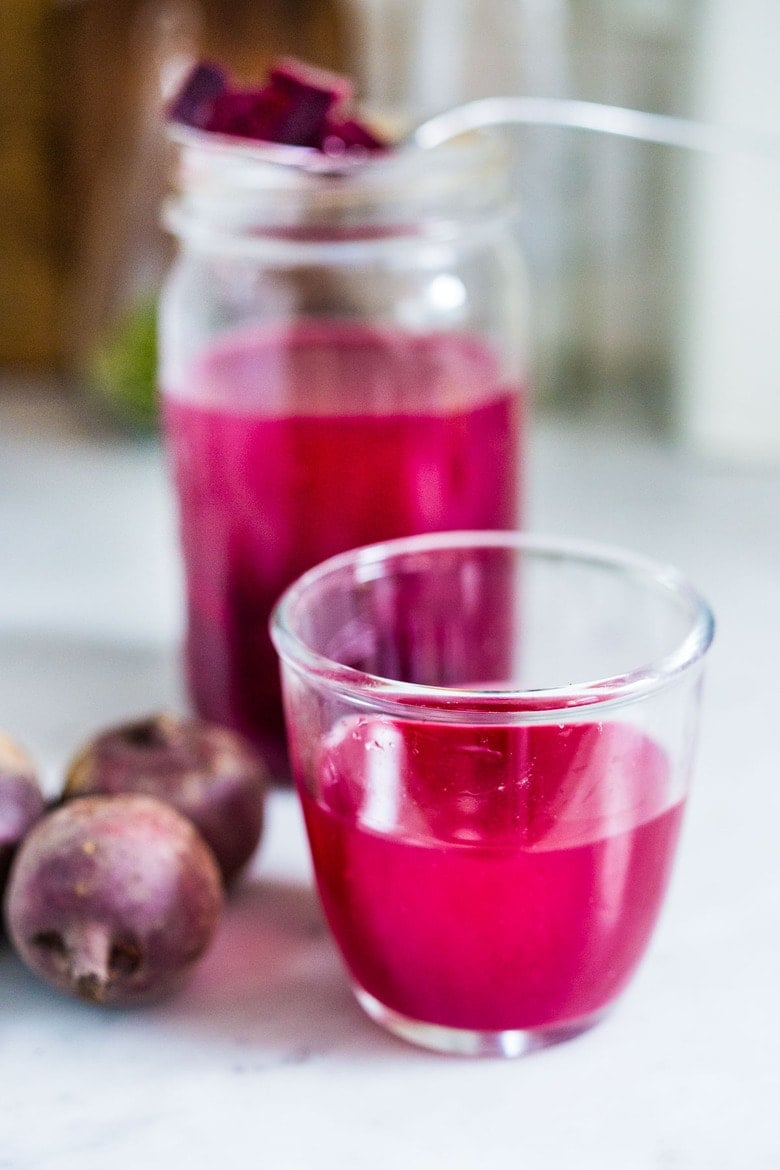
Here is a fun little recipe I’ve been playing around with for years now- Beet Kvass! Beet kvass is a fermented probiotic drink that hails from Eastern Europe that is tangy, earthy, salty and slightly sweet from the beets. Full of gut-healthy probiotics, it’s a simple way to add diversity to our microbiome and, in turn, support our immune system.
It differs from Kombucha or Water Kefir in that this fermented drink is savory and briny, made with salt, rather than sugar, more like our gut shot or pickle brine.
It takes about 15 minutes of hands-on time and 5-7 days of fermentation time to make your first batch using whey (the liquid from strained yogurt). Whey significantly speeds up the fermenting process and requires less salt. You can also use store-bought kvass as a “starter ” for your first batch. And know that it is absolutely possible to make beet kvass without whey or a starter, but it can take up to 2 weeks, and you’ll need to use more salt- make sure to read the recipe notes!
Why you’ll love Beet Kvass
- Easy to make– takes 15 minutes of hands-on time before letting Mother Nature take its course (5-7 days).
- Made with simple ingredients– just beets, salt, and water! We use whey for the first batch to jump-start the process, but after that you can use your own batch of kvass.
- Gut-supporting! Filled with billions of healthy probiotics in just one tablespoon!
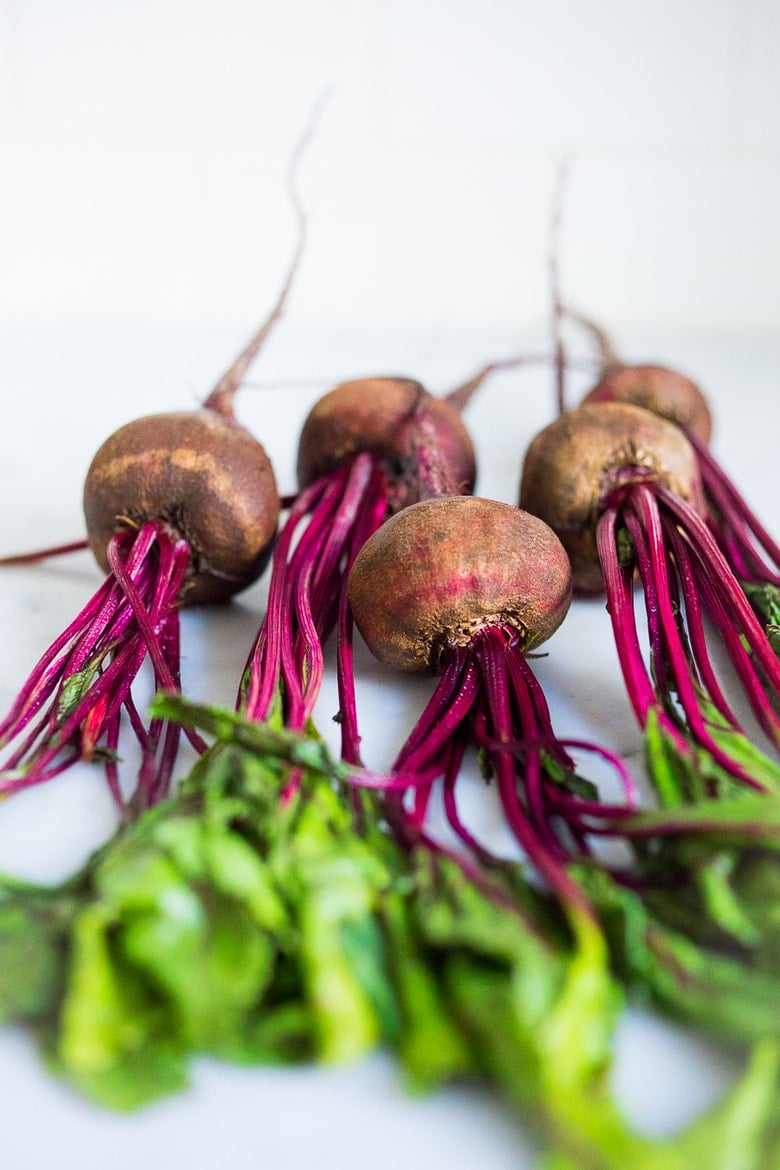 Beet Kvass Ingredients
- Organic beets– I love the color of red beets, but yellow beets works fine too! Use organic, unpeeled beets.
- Fine sea salt– you want to use natural, unprocessed salt when fermenting.
- Filtered water– chlorine in tap water can suppress fermentation, so use filtered if possible.
- Whey – To shorten the fermentation process, add whey (the liquid from straining yogurt). Strain 1-2 cups of yogurt through a fine-mesh strainer lined with cheesecloth. Collect the liquid; this is the whey! You can also use Kvass from a previous batch, or store-bought beet kvass (as a starter). Sauerkraut or pickle brine (without vinegar) can also work in a pinch.
- 2-quart mason jar (or 2 x 1-quart jars) with a lid. (For experienced fermenters, feel free to use airlocks)
Optional Beet Kvass Flavorings
- Fresh dill (or fennel fronds), bay leaves, or other herbs.
- Pickling spices (fennel seed, dill seed, peppercorns, celery seeds, caraway, etc) to prevent floating; add them to the jar first or use a fine-mesh spice bag.
- Sliced onion and/or garlic cloves.
- Fresh sliced ginger or turmeric root.
How to make Beet Kvass (instructions)
- Prep: Wash hands and jar well using soap.
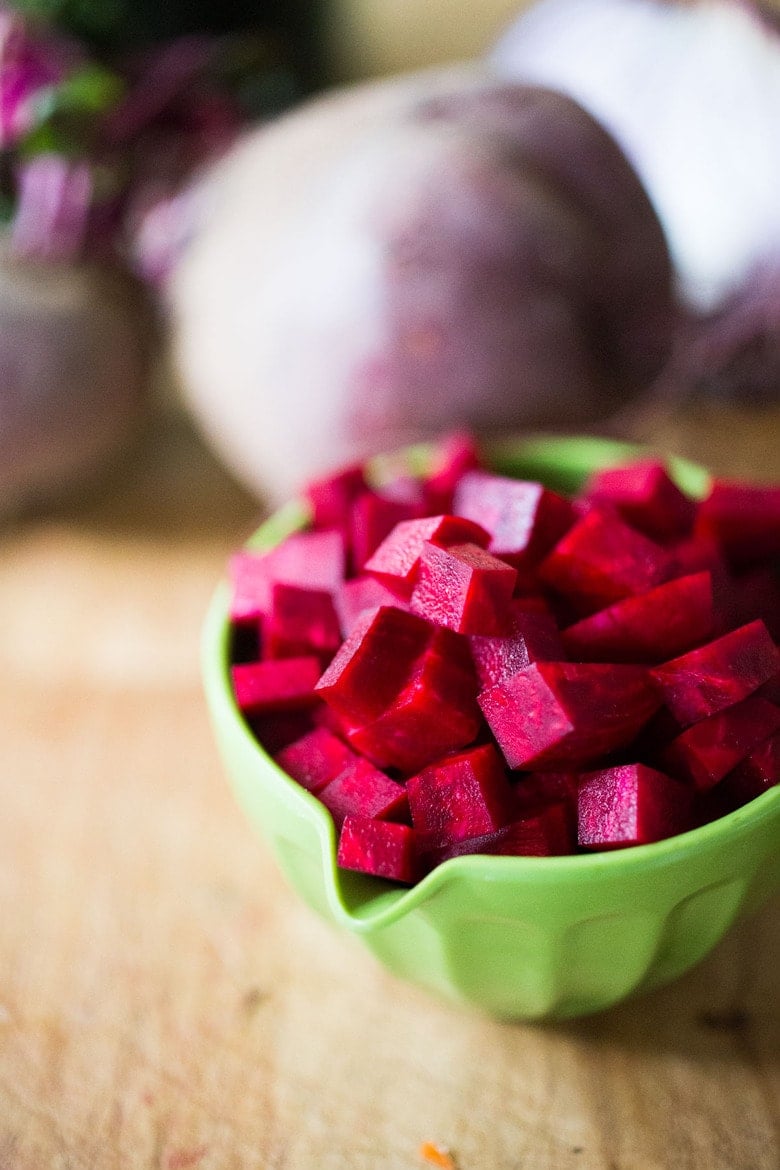
- Rinse and slice the beets into ½-inch-thick rounds, then dice them into cubes, leaving the skin on. Grating or cutting any smaller will release too much of the sugar too quickly.
- Place beets in a clean, 2-quart mason jar. If adding herbs or seeds, add these before adding the beets.
- Brine. Mix 3 cups of water with 1 tablespoon of fine sea salt.
- Combine. Pour this brine into the jar along with the whey. Then fill the jar with more water, leaving 1 inch of headroom. Remove any floating seeds or herbs with a slotted spoon- anything that rises above the brine can mold. Tip: If adding a lot of spice seeds, use a fine-mesh spice bag to prevent them from rising to the top.
- Cover with a loose-fitting lid. Place in a shallow bowl or baking dish (to collect any overflow).
- Ferment: Place the jar in a cool, dark place; 60°F-70°F (basement or lower cupboard is ideal). Check every couple of days for cloudiness, bubbles, or overflow- all signs of fermentation- roughly 3-5 days. The longer it ferments, the more tangy it will taste, so you can ferment “to taste.” For an even tangier flavor, continue fermenting for 1-2 more weeks. Once happy with the flavor, refrigerate.
- Refrigerate and store. Either strain or leave beets in; I leave mine in- yes, you can eat them. It will continue to ferment in the fridge, but at a much slower rate, developing more depth of flavor. The sugar from the beets will continue to feed the healthy bacteria. Beet Kvass will keep indefinitely in the fridge. If you notice any white foam on top of your kvass, it is most likely kahm yeast and harmless. Skim it off with a spoon and toss. If you see mold, I would discard the batch.
How to drink Beet Kvass
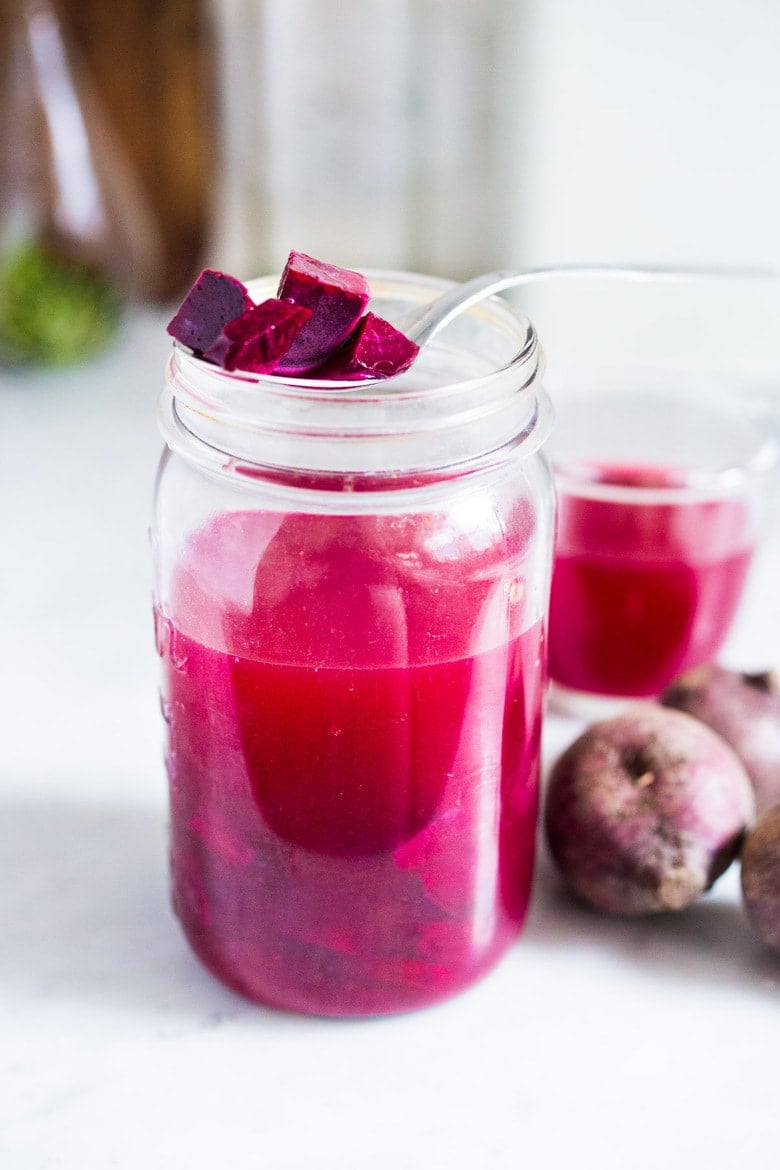
If new to fermented foods, start slowly. Drink a tablespoon first and see how you feel. You are adding millions of probiotics to your gut in just a tablespoon. This creates diversity in the gut, which is thought to be healthy! You could take a sip with every meal if you like, or take a shot once a day. I like to drink a shot in the afternoons for a refreshing pick-me-up. If it tastes too strong for you, you can water down the portion you are drinking. Yes, you can eat the beets!
Troubleshooting
- If you notice any white foam on top of your kvass, it is most likely kahm yeast and harmless. Skim it off with a spoon. The Kvass will have a slightly cloudy appearance; this is fine!
- If you see any mold, I would personally discard the batch. There are many opinions on this, but this is what I would do. I used to be more lax, just removing the molded object, but I’ve changed my mind here!
- Beet Kvass should smell tangy and good like pickle brine – if it smells “off”, don’t drink it. A bad bacteria may have inadvertently been introduced – perhaps an unclean jar or utensils or dirty hands. It is easy to do.
- If your kvass doesn’t smell slightly sour or tangy, it likely hasn’t fermented or hasn’t fermented long enough. This could be due to not using the right salt ratio or chlorine in your water, or a contaminated jar (or hands).
More Fermented recipes you may like:
- How to Make Kombucha
- Probiotic Gut Shot
- 20+ Easy Delicious Beet Recipes
- Beet and Cabbage Sauerkraut
- How to make WATER KEFIR | an easy Guide!
- 25 Immune System-Boosting Recipes!
- How to Make Kimchi! A Quick Easy Authentic Kimchi Recipe
- How to make Sauerkraut (Simple Cultured Cabbage)
- Ginger Turmeric Shots
- 50+ Drink Recipes
Description
How to Make Beet Kvass! An Eastern European probiotic drink made with beets, sea salt and water. Full of healthy probiotics from the Lacto-fermentation, Beet Kvass is believed to help boost immunity. It tastes slightly sweet, tangy, earthy and salty- but in a good way! With just 10 minutes of hands-on time,it is so simple- just let Mother Nature take its course. (Allow 1-2 weeks for fermentation- see notes for speeding up this process.)
Ingredients
- 2 medium-large beets, organic (2 cups diced, with skin on)
- filtered water (tap water may have too much chlorine & inhibit fermentation)
- 1 scant tablespoon fine sea salt
- 1/4 cup whey (the liquid from strained yogurt) or use a previous batch of kvass; *see notes.
- 2-quart mason jar (or divide everything among two 1-quart jars)
Instructions
- Prep: Wash hands and jar well.
- Rinse and slice the beets into ½-inch-thick rounds, then dice them, leaving the skin on.
- Place beets in a clean, 2-quart mason jar. *See notes if adding other spices-you’ll need to place these in the jar first.
- Brine. Mix 3 cups of water with 1 tablespoon of fine sea salt.
- Combine. Pour this into the jar along with the whey. Then fill the jar with more water, leaving 1 inch of headroom. Remove any floating seeds or herbs with a slotted spoon- anything that rises above the brine can mold.
- Cover with a loose-fitting lid. Place in a shallow bowl or baking dish (to collect any overflow).
- Ferment: Place the jar in a cool, dark place; 60°F-70°F (basement or lower cupboard is ideal). Check every couple of days for cloudiness, bubbles, or overflow- all signs of fermentation- roughly 3-5 days. The longer it ferments, the more tangy it will taste, so you can ferment “to taste.” For an even tangier flavor, continue fermenting for 1-2 more weeks. Once happy with the flavor, refrigerate.
- Refrigerate and store. Either strain or leave beets in; I leave mine in- yes, you can eat them. It will continue to ferment in the fridge, but at a much slower rate, developing more depth of flavor. The sugar from the beets will continue to feed the healthy bacteria. Beet Kvass will keep indefinitely in the fridge. If you notice any white foam on top of your kvass, it is most likely kahm yeast and harmless. Skim it off with a spoon and toss. If you see mold, I would discard the batch.
Notes
Beets. Grating the beets or cutting them smaller will release too much of the sugars, too quickly. A ½ inch dice is perfect. Do not peel!
Salt and Whey. When using whey, you’ll need less salt. If making kvass without whey, I would use more salt. Add 1 scant teaspoon per 1 cup of water. (2% ratio).
Optional Additions: Add these to the jar first – fresh dill (or fennel fronds), bay leaves, or other herbs, Pickling spices (fennel seed, coriander seed, dill seed, peppercorns, celery seeds, caraway, etc.), sliced onions, shallots, garlic, or turmeric root. Be sure to remove any that float to the top.
Storage: Store this in the fridge, strain into a cup, and drink a few ounces daily. Yes, you can eat the beets!
Tip: to prevent any seeds from floating to the top (which can mold), either add them to the jar first, place beets over the top of them, or place them a small mesh bag. Remove any that float to the surface.
This will last indefinitely in the fridge. I highly recommend making a double batch of this because of the longer fermentation time.
Flavor this up!!! I love adding onion, garlic and pickling whole spices. You can get small mesh cotton bags to put your spices in if you like, then no worries about “floaters.”
Fermentation slows down in cooler places and speeds up in warmer places.
Nutrition
- Serving Size: ½ cup
- Calories: 20
- Sugar: 3.1 g
- Sodium: 1202.8 mg
- Fat: 0.1 g
- Saturated Fat: 0 g
- Carbohydrates: 4.3 g
- Fiber: 1.3 g
- Protein: 0.7 g
- Cholesterol: 0 mg



I love any dish featuring beets. Probiotic shots are great. Thank you for sharing this new favorite. Your writing style makes it easy to read recipes then eat the prize.
Glad to hear this Mary! Appreciate you taking time to let us know.
Dont forget beets are high in nitrate which is converted to nitric acid in the body. A great vasodilator…esp for those of us that have carotid artery blockages
Hey there, thanks for sharing your recipe. This is my first time ever doing this, I’m on day 3 and it STINKS so bad. Is this normal, I guess it’s a pungent smell that I can’t compare to anything. I’ve been removing floaters daily and have stuck a brand new cotton cloth in it to prevent the rest of everything from hitting the surface. I’m hoping the smell doesn’t mean that it’s going bad in some way.
Hi Jaimee- it should not stink in a bad way. I wonder if it got contaminated by something? Were the jar, utensils and hands very clean?
Hi Sylvia, thanks so much for your reply and sorry for the delayed response. Everything was cleaned properly prior and I wasn’t cooking anything else or sharing utensils with cooking another meal. I ended up persevering and the weird smell settled down? I also inspected for mould and there wasn’t any what so ever just the healthy yeasty stuff. It turned out amazing. I’m wondering if what I could smell was just how it smells? Regardless, love this and about to make again. Thank ❤️
Perhaps it was just the fermentation smell Jaimee! Glad to hear it tuned out for you!
Just one more note:
It says for 1/2 portion: 1 medium beets, 2 cups diced, skin ON.
And for double portion: 4 medium beets, 2 cups diced, skin ON.
How many cups?
And “see notes for doubling, recommended”, can’t find the note.
So I kind of gambled I guess with my amount of beets cause my beets are really small.
The multiplier was not working, I updated it and it is all fixed now. 🙂
Hi! Just asking about beet size. My beets are rather small. One beet weighing about 70 grams (max 100 grans). How many grams would your beet be? 2 beets?
Hi Meri! A medium beet weighs around 130-140 grams. So 2 beets would be roughly 260-280 grams.
Hello
I know this may sound off…but do you cook the beets first or slice straight from raw
Thanks.
Hi Jan, They go in raw!
Hi there, I made this recipe 2.5 weeks ago but only the large jar has very little bubbles. The others are very flat and taste extremely salty. One of the small jars is bright red in colour, the other two turned dark red, almost brown. Is it possible the fermentation process hasn’t started? I live in a cool climate. Any idea if I can save this batch?
Hi Alicia, they should have started by now. Sounds like the large jar may have started? You could try adding a little whey? The liquid from plain yogurt.
Is this safe to drink in pregnancy considering the fermentation process?
I used cultured and fermented foods throughout my pregnancies and my kids love them now too! Beet kvass is high in folate great for baby’s development. But always be sure to discuss this with your doctor or midwife.
thanks for a great recipe
Glad you enjoyed Bee!
First time trying this! I’ve been fermenting it for the past 2 weeks but there are no bubbles when I tap the jar. It also tastes very tangy. Is this normal?
Hi Katrina! So the tangy flavor is a great indication that it IS fermenting. Normal and sounds perfect. You can refrigerate it at any time. 🙂
Just wanted to come back here and say this recipe is SO easy and delicious! Now I’m used to the tangy fermented flavor it’s something I’m constantly reaching for and even give it to my little one in his meals.
Love this Katrina, so important to introduce it to kids!
How do you make juice from it though. Do I put it in a juicer or blender?
The beets are fermenting in water- basically the water turns into the “juice”.
Do I add cold, warm or hot water/salt mix to the jar? Does it matter?
Room temperature water is fine. The salt will dissolve as it ferments.
This got moldy for me, bummer! The problem with adding things like coriander seeds is that they float to the surface and grow mold. How do you prevent them from floating to the top?
Hi Sara- I am so sorry about that. I added more notes to prevent this. I would add the seeds to the jar first, and layer over top. If any float to the surface, remove daily. You can also purchase little cotton mesh bags, handy if you are making this a lot!
How can i prevent the mold? I tried to make it 3 times, and every time it got mold on top. Some questions:
– do you need to solve all the salt in the water? Or just place it in the jar at the bottom?
– Do you need to place the jar in a dark place?
– Does it also work in a fermentation jar where you prevent any air to get into the jar?
Hi Sybren, sorry to hear this, and it sounds frustring! Are you spices rising to the top, or what is actually touching the surface that is getting moldy? Yes dissolve all the salt- 1 heaping tablespoon in 3 cups water. A dark place is great. Yes it will work in a fermentation jar. Are you able to add brine from another ferment, or whey?
Hey thanks for your reply. I was a bit busy so I haven’t tried to make te kvass again.
When I make it I do not use any spices yet, I just want to make a plain kvass.
It looks like a slimy foamfloating on the surface. I scoop it out with a spoon that I first placed in a glass of cooking hot water. Could I just leave the foam in? Or can I take it out in another manner?
I haven’t triedit with a brine or whey. Can I than just use a little bit of brine from sauerkraut? Or from a bottle of saurkraut juuice?
Hi Sybren, it sounds like it may be the foamy bubbles from fermenting? Yes, You can use sauerkraut brine as long as it is “fermented” (found in the refrigerator section), and not pickled with vinegar. Make sure your jar and utensils are clean. 🙂
Hey, I made it with 2 or 3 table spoons of saurkraut brine and it looks totally different!! The foam on top now looks dry and, after 5 days no mold!! it smells a bit sour, but good. Unfortunately i cannot post a picture, but i think it’s going the right way!! I’ll let you know.
Great to hear! Adding the brine is helpful!
Wrap your spices in cheesecloth, or a small piece of cotton fabric (cut from an old discarded tee shirt?). Just make sure it’s really clean. Even boil it for a few minutes. You don’t want to introduce any unwanted bacteria. It will turn a pretty pink color!
It’s not mold, it’s the fermenting foam from the beets that due to the dark color looks like mold. It’s not. Salt kills the harmful bacteria that forms mold.
Seeds and whole spices can be contained in a small pouch of cheesecloth. Keeping an airlock lid on and not opening until it’s ready to drink will help avoid mold. Mold and kahm yeast need oxygen to grow.
This turned out good!
Cool. Just tested my batch after 2 weeks. Tastes great… In a strange, lacto-fermented way. 😆 Very pretty too.
Any recommendations on what to do with the beets?
Add to salads and soups!
Will try this recipe this week!
Looks good!
Great!
A little tip about the beets after they’re no longer needed in the kavass…Gaps diet recommends using fermented vegetables in soups as they contain additional nutrients and any anti nutrients are broken down making them easily digested. I have done this with my homemade sauerkraut. It’s delicious and very healing for damaged guts. ☺️
Thanks so much Barbara!
You can definitely add the fermented beets to any dish but heating them can kill the beneficial bacteria, or probiotics in the food. As long as the temperature of what you’re adding them to is no higher than 108 degrees, you’re good to go!
Mine had some mold on top as well. If it’s because of anything besides the brine touching the air, would you suggest placing something to hold everything below the surface? Otherwise, no matter how much brine I put in the jar, the beets will float to the top. Thank you!
Yes Taylor you can use a fermentation weight if needed, or place a cabbage leaf overtop the beets and push it down under the brine. IThis is so strange… I make this all the time and the beets always sink to the bottom. But yours float?
Taylor, my beets always float to the top as well. I always use a cabbage leaf and a fermentation weight on top, just to make sure nothing can sneak up to the surface. It’s so disappointing when you ferment something for a week+ and have to throw it out because of mold. I hate that. ☹️
Hi! So I tried making this and we are about a week in. There is mold on top. In the instructions you said to keep the lid loose fitting so I didn’t tighten it. Could that be why?
Shoot Sara- Mold happens when something other than the salt water touches the air. Were any of the beets or spices floating at the top? The lid should be loose.
At what step do you add the add flavors to the beet kvass? I would like to add ginger but not sure how much or when to add to the recipe. Thank you!
Hi Anita- you could add slices of ginger right at the beginning!