Description
Learn how to make homemade pasta from scratch, the easy way. Made with simple ingredients and my best chef tips for perfect pasta every time.
Ingredients
- 2 cups 00 flour or all-purpose flour, spooned and leveled
- 3 large eggs
- 2 teaspoons olive oil
- 1/2 teaspoon sea salt
- Water as needed
- Optional: Rice flour for dusting (the best for not sticking) or use AP flour.
- Optional: Semolina flour (for added texure and sturdiness); see notes.
Instructions
- Mix the pasta dough. Add the flour to a large bowl and create a well in the center for the eggs, olive oil and salt. Add the eggs, olive oil, and salt to the well in the middle and whisk with a fork until smooth-ish. Then, start mixing in the flour with the fork until it is mostly incorporated. Next, use your fingers to incorporate the flour, pinching the flour into the dough until you have a craggy, cohesive ball. *Add water a few teaspoons at a time as needed to incorporate all the flour. If it feels really sticky, add a little more flour. Place on a floured surface and rest for 10 minutes.
- Knead. Knead the dough until smooth and elastic, roughtly 5-7 minutes. Use the heel of your hand to press the dough down, away from you, onto the counter, then fold. Keep pressing and folding the dough, repeating until it is smooth and elastic. It will feel stiff at first, but it will relax.
- Second Rest. Made a smooth ball, wrap, and rest for 20-30 minutes on the counter ( or wrapped tightly overnight in the fridge.)
- First Roll. Ready 2 extra-large sheet pans, lightly dusted with flour (rice flour works great here). Divide the dough into 4 pieces. Dust your work area with flour. Working with one piece at at time (wrap the rest) flatten the dough into a long oval, not wider than your pasta maker. Roll on the thickest setting (2x), then fold the dough in half, and roll again on the thickest setting. Fold the dough in thirds, flour and roll again (2x), and repeat until the dough is smooth and even-textured, and about the width of the pasta maker. Dust with flour as needed, and roll the dough at slightly thinner settings until it’s about ¼ inch thick. Don’t pull on the dough, just let it gently rest on the floured surface as it comes out.
- Rest again. Lightly dust both sides, place on the sheet pan, fold over, cover with a kitchen towel, and let rest while you repeat the process with the three other pieces.
- 2nd Roll. Once all 4 pieces are done and rolled to ¼ inch thick, and rested at least 10 minutes, it’s time to roll them thinner. Starting with the most “ rested” dough, run it through the pasta maker 2 times at each level, gradually thinning and sprinkling with flour as needed until you get it to the 1/16th -inch thick level. Don’t pull on the dough, just gently nudge it out on the floured surface as it comes out. Dough should be silky smooth and almost see-through. Repeat with the remaining 3 pieces, dusting, covering as you go.
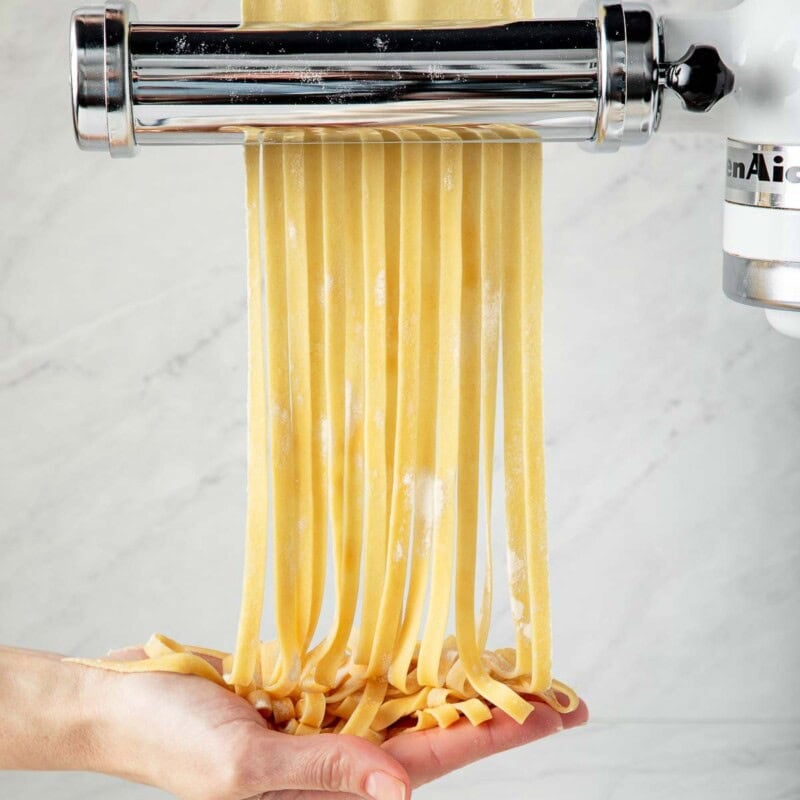
- Cut the pasta. Trim the ends and cut the long sheets in half. Run each sheet through your pasta cutter, making sure to heavily dust with flour after, and coil around your hand, creating little nests on the dusted sheet pan. Cover. Alternatively, cut by them hand.
- Dust lightly with rice flour and store in “nests” in an airtight container until using, up to 3 days. Single or shallow layers are best here.
Notes
00 flour: Double-zero flour is extra-fine ground flour, similar in texture to cornstarch. It makes the most tender pasta ( typically used in Italy) but is generally used in conjunction with a bit of semolina flour. All-purpose flour is perfectly acceptable and yields both tender and slightly chewy results.
Semolina flour: Substitute 10-25% semolina flour for a sturdier, chewier pasta that holds its shape- especially useful when using your pasta extruder (penne, spaghetti, macaroni, rigatoni). Use 10% semolina flour when making pasta sheets for ravioli or tortellini.
Tip: Semolina gives bite; 00 flour gives silkiness. The more you lean toward semolina, the firmer and more rustic your pasta will be.
Rice flour: Rice flour is a godsend when dusting pasta- you’ll use less, and it prevents sticking!
Nutrition
- Serving Size: 4 ounces
- Calories: 311
- Sugar: 0.3 g
- Sodium: 345.5 mg
- Fat: 7.7 g
- Saturated Fat: 1.8 g
- Carbohydrates: 48 g
- Fiber: 1.7 g
- Protein: 11.2 g
- Cholesterol: 139.5 mg